Book Prohibition Law
The Book Prohibition Law is the central legal and cultural edict of the dystopian society in Fahrenheit 451, making it a crime to own or read books and requiring firemen to burn any discovered volumes. The law is not a sudden imposition but the endpoint of a long historical process driven by mass media, minority pressure, and a collective desire for uncomplicated happiness, as Captain Beatty explains to Montag. Its enforcement is the sole purpose of the firemen, who use kerosene and flamethrowers to destroy books and, in extreme cases, the people who refuse to surrender them.
Origins and Justification
The law's official history, as recorded in the firemen's rulebooks and recited by Stoneman and Black, claims it was established in 1790 to burn English-influenced books in the Colonies, with Benjamin Franklin as the first fireman. However, Beatty provides a more nuanced account, tracing the law's real origins to the Civil War era and the rise of photography, motion pictures, radio, and television. As population grew and media became mass-oriented, books were condensed, simplified, and eventually deemed dangerous because they fostered disagreement and unhappiness. Beatty argues that the law did not come from the government down but from technology, mass exploitation, and minority pressure: "There was no dictum, no declaration, no censorship, to start with, no!" The goal was to eliminate anything that made people feel inferior or troubled, replacing intellectual depth with constant entertainment. The law's ultimate rationale is the Happiness Imperative: people want to be happy, and books—with their conflicting ideas and demands on attention—threaten that happiness.
Enforcement and the Firemen
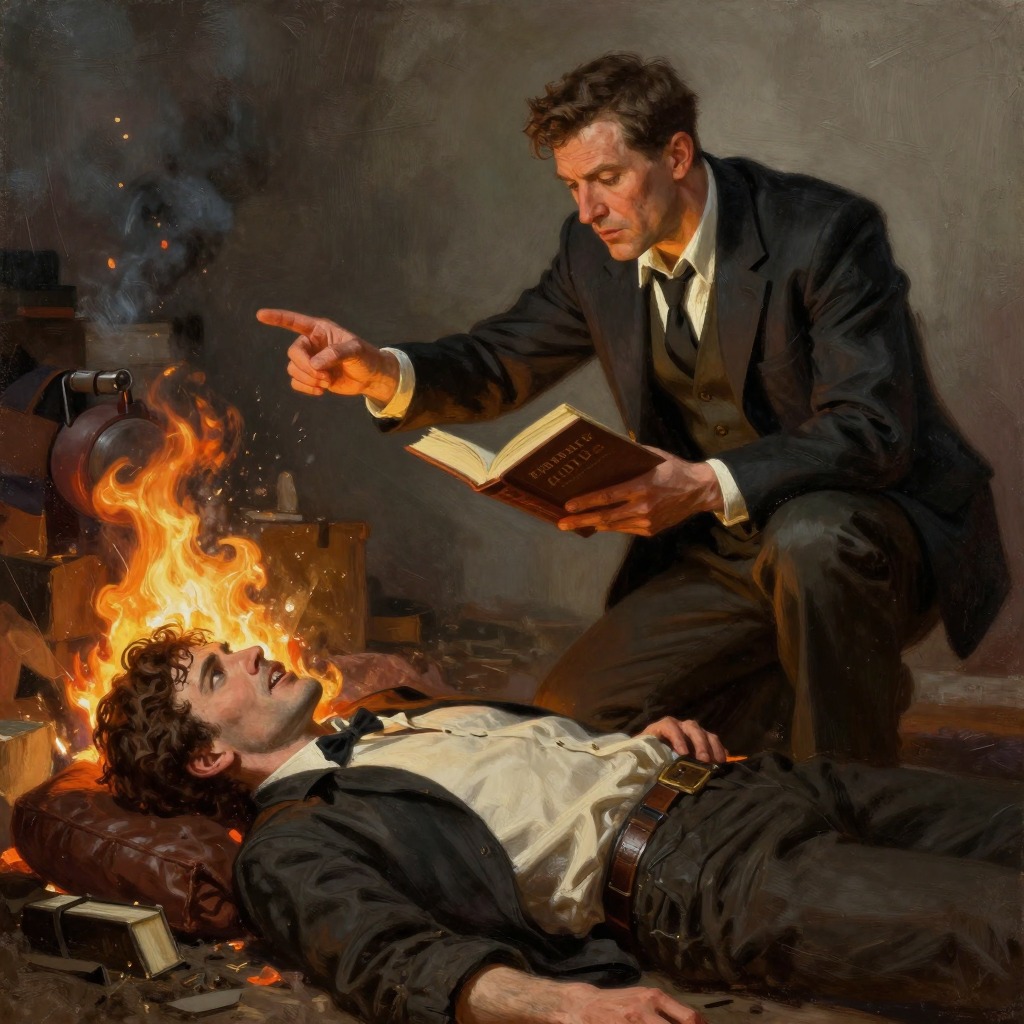
The Book Prohibition Law is enforced by a specialized fire department whose members, like Montag, are trained to start fires rather than extinguish them. The firemen's five rules, displayed in their rulebooks, are: "1. Answer the alarm swiftly. 2. Start the fire swiftly. 3. Burn everything. 4. Report back to firehouse immediately. 5. Stand alert for other alarms." Firemen use kerosene hoses and flamethrowers to burn books and the houses that contain them, often at night for greater spectacle. The Mechanical Hound, a robotic creature with a highly sensitive olfactory system, is used to track down book owners who resist or flee. The law is absolute: even a single book hidden in a home is grounds for burning the entire house, as Montag discovers when his own home is targeted after Mildred and her friends report him. The firemen are also authorized to arrest and execute those who violate the law, as Beatty does when he places Montag under arrest after forcing him to burn his own house.
Consequences and Resistance
The law's enforcement leads to the destruction of countless books and the deaths of those who refuse to comply. The most dramatic example is the old woman who, when her books are discovered, chooses to burn herself alive rather than surrender them, quoting the martyrdom of Latimer and Ridley: "Play the man, Master Ridley; we shall this day light such a candle, by God's grace, in England, as I trust shall never be put out." Montag himself becomes a criminal after stealing a book and later killing Beatty, forcing him to flee the city. The law also creates a class of outcasts—the Book People—who memorize entire books to preserve knowledge, living as wanderers on the abandoned railroad tracks. Granger, their leader, explains that they are "book-burners, too," having read and then destroyed the physical books to avoid detection, keeping the knowledge safe in their heads. The law's ultimate failure is revealed when the city is destroyed by atomic bombs, suggesting that a society that suppresses knowledge cannot survive.
Thematic Significance
The Book Prohibition Law serves as the central symbol of the novel's critique of censorship, anti-intellectualism, and the pursuit of happiness at the expense of truth. It represents the triumph of conformity over individuality, of entertainment over thought, and of immediate pleasure over lasting meaning. The law is not merely a political decree but a cultural consensus, as Beatty emphasizes: "We must all be alike. Not everyone born free and equal, as the Constitution says, but everyone made equal." By making books illegal, the society has eliminated the primary source of uncomfortable questions and conflicting ideas, creating a world where people are "happy" because they never have to think. Montag's journey from enforcer to violator of this law mirrors his awakening to the value of knowledge and the emptiness of a life without it.